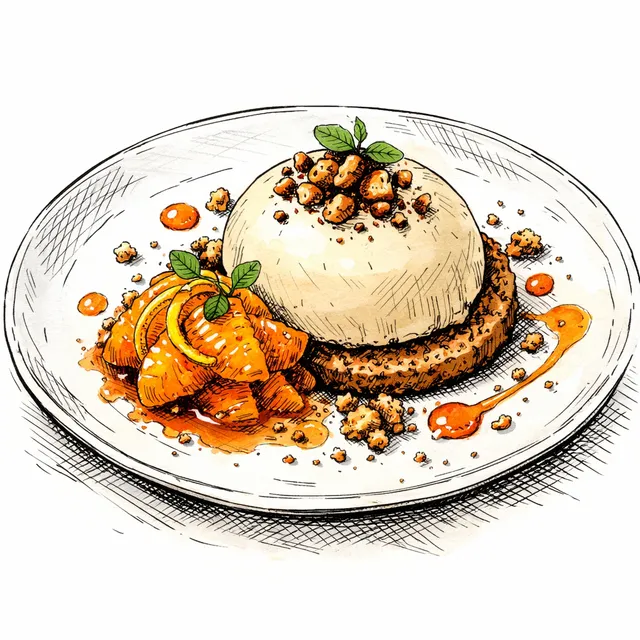
Cold-Infused Roasted Chestnut Bavarois with Tart Satsuma Confit & Brown Butter Sablé
An autumn study in temperature and texture: cold-steeping roasted chestnuts into dairy extracts pure, mellow sweetness without starchiness or bitterness. Paired with a shatteringly crisp brown butter sablé base and the sharp, floral acidity of quick satsuma confit, every bite delivers clean, calibrated contrast.

Save a copy to your collection for editing
Timeline
Ingredients
- 200 g roasted peeled chestnuts(roughly crushed; vacuum-packed or freshly roasted)
- 300 g whole milk(cold, for infusion)
- 300 g heavy cream(chilled, divided into 100g for base and 200g for whipping)
- 5 g sheet gelatin(silver strength (about 2.5 sheets), bloomed in ice water)
- 60 g large egg yolks(approx. 3 yolks, room temperature)
- 95 g granulated sugar(divided: 45g for bavarois, 25g for crust, 25g for satsuma confit)
- 2 g fine sea salt(divided: 1g for sablé crust, 1g for bavarois custard)
- 75 g unsalted butter(browned and cooled to room temperature)
- 90 g all-purpose flour(for sablé crust)
- 3 satsuma mandarins(zested and segmented; unpeeled weight approx. 300g)
- 10 g fresh lemon juice(to brighten the citrus confit)
- 1 g flaky sea salt(Maldon or similar, for finishing)
- 100 g heavy cream(Used in step 1 for cold-steeping.)
- 25 g granulated sugar(Used in step 2 for the sablé dough.)
- 1 g fine sea salt(Used in step 2 for the sablé dough.)
- 45 g granulated sugar(Used in step 5 for the custard base.)
- 1 g fine sea salt(Used in step 5 for the custard base.)
- 25 g granulated sugar(Used in step 7 for the confit.)
Instructions
- 1
In a clean glass container, combine 200 g roasted peeled chestnuts, 300 g whole milk, and 100 g heavy cream. Cover tightly, label with painter's tape, and chill in the refrigerator for 12 to 24 hours. Cold-steeping extracts deep, toasted nut aromatics without pulling heavy, starchy cloudiness into the dairy.
5 min
Tip: Crush the chestnuts coarsely with your fingers or a rolling pin before submerging to maximize surface contact.
- 2
Preheat your oven to 175°C (350°F). Line an 8-inch square metal baking pan with parchment paper, leaving a 2-inch overhang on opposing sides. In a small bowl, mix 75 g unsalted butter (browned and cooled), 90 g all-purpose flour, 25 g granulated sugar, and 1 g fine sea salt until a damp, sandy dough forms.
8 min
Tip: Brown the butter ahead of time until hazelnut-brown, then let it solidify slightly to room temperature so the crust doesn't weep oil.
- 3
Press the sablé dough evenly into the bottom of the prepared pan using the flat base of a measuring cup. Dock all over with a fork. Bake at 175°C for 14 to 16 minutes until golden brown and dry to the touch. Remove and allow to cool completely on a wire rack.
16 min
Tip: A firm, even press guarantees a clean, level slice later without crumbly breakage.
- 4
Submerge 5 g sheet gelatin in a bowl of ice-cold water to bloom for 5 minutes. Strain the cold-infused dairy through a fine-mesh sieve into a medium saucepan, pressing gently on 200 g roasted peeled chestnuts with a flexible spatula to extract the infused liquid (you should have about 320g of chestnut cream), then discard the solids.
6 min
Tip: Do not squeeze the chestnut solids violently; gentle pressing keeps the custard clean and silky instead of mealy.
- 5
Warm the strained chestnut dairy over medium-low heat until steaming (approx. 70°C). In a separate heatproof bowl, whisk together 60 g large egg yolks, 45 g granulated sugar, and 1 g fine sea salt until slightly pale, about 1 minute.
4 min
Tip: Whisk yolks and sugar immediately upon contact to avoid sugar burn on the yolks.
- 6
Pour one-third of the hot chestnut milk into the yolks, whisking constantly to temper. Return the entire mixture to the saucepan over medium-low heat. Cook, stirring constantly with a silicone spatula along the bottom, until the custard coats the spatula and hits 82°C (180°F). Immediately take off heat, squeeze excess water from 5 g sheet gelatin, and stir it into the hot custard until dissolved. Strain into a wide, clean bowl and set over an ice bath, stirring occasionally until chilled to 20°C (68°F).
8 min
Tip: Precision is freedom here: pull at 82°C. Going over 84°C scrambles the egg proteins.
- 7
While the custard cools over the ice bath, make the confit. In a small saucepan over medium heat, combine the segments and finely grated zest of 3 satsuma mandarins, 25 g granulated sugar, and 10 g fresh lemon juice. Simmer gently for 6 to 8 minutes, gently stirring, until the juices turn glossy and lightly jammy. Remove from heat and chill thoroughly in the refrigerator.
8 min
Tip: Remove all white pith from the mandarin segments for a vibrant, bitterness-free confit.
- 8
In a chilled bowl, whip the remaining 200 g heavy cream to medium peaks (softly holding its shape with a gentle droop). Gently fold one-third of the whipped cream into the cooled chestnut custard (at 20°C) to lighten it, then fold in the remaining cream in two additions using a wide silicone spatula until uniform.
5 min
Tip: If the custard is too warm, it melts the cream; too cold, the gelatin seizes. 20°C is the sweet spot.
- 9
Pour the aerated chestnut bavarois over the completely cooled sablé crust in the pan. Smooth the top with a small offset spatula. Tap the pan once firmly on the counter to eliminate air pockets. Transfer to the refrigerator and chill uncovered for at least 4 hours (or overnight) until completely set.
5 min
Tip: Let it cool. Future you deserves clean slices.
- 10
Gently lift the set slab from the pan using the parchment paper overhang. Transfer to a clean cutting board. Run a sharp slicing knife under hot water, wipe it dry, and trim the ragged outer edges, then portion the bavarois into 8 neat rectangles (wiping the blade between every cut). Spoon 3 satsuma mandarins chilled confit across each bar, and finish with a deliberate pinch of 1 g flaky sea salt.
5 min
Tip: A hot, dry knife is non-negotiable for restaurant-sharp cuts through the gelatin-set cream and crisp sablé.
Chef's Notes
Why this works: Chestnuts contain delicate volatile sugars alongside dense starches. When boiled or pureed directly into custards, they turn gritty, pasty, and overly heavy. Cold-infusing whole crushed roasted chestnuts into milk and cream overnight selectively extracts their sweet, earthy essence while leaving insoluble fibers behind. Satsuma mandarins provide high-toned acidity to slice through the richness, while browned butter in the sablé grounds the nutty profiles together. Fix it fast: If your custard sets slightly too fast over the ice bath before folding in the cream, gently whisk it over a pot of barely simmering water for 5 seconds to fluidize the gelatin before folding. Precision is freedom.
Frequently Asked Questions
How long does Cold-Infused Roasted Chestnut Bavarois with Tart Satsuma Confit & Brown Butter Sablé take to make?
Cold-Infused Roasted Chestnut Bavarois with Tart Satsuma Confit & Brown Butter Sablé takes about 1 hour total. That includes 35 minutes of prep and 25 minutes of cooking.
How many servings does this recipe make?
This recipe makes 8 servings.
What skill level is needed for Cold-Infused Roasted Chestnut Bavarois with Tart Satsuma Confit & Brown Butter Sablé?
This recipe is rated medium — it's intermediate, requiring some cooking experience.
What ingredients do I need for Cold-Infused Roasted Chestnut Bavarois with Tart Satsuma Confit & Brown Butter Sablé?
The main ingredients are: roasted peeled chestnuts, whole milk, heavy cream, sheet gelatin, large egg yolks, granulated sugar, fine sea salt, unsalted butter, all-purpose flour, satsuma mandarins, fresh lemon juice, flaky sea salt, heavy cream, granulated sugar, fine sea salt, granulated sugar, fine sea salt, granulated sugar.
What type of meal is Cold-Infused Roasted Chestnut Bavarois with Tart Satsuma Confit & Brown Butter Sablé?
Cold-Infused Roasted Chestnut Bavarois with Tart Satsuma Confit & Brown Butter Sablé is categorized as: dessert.
Ask Theo Glass a question
Sign in to chat about this recipe, get cooking tips, and ask for substitutions.
Sign in to chat