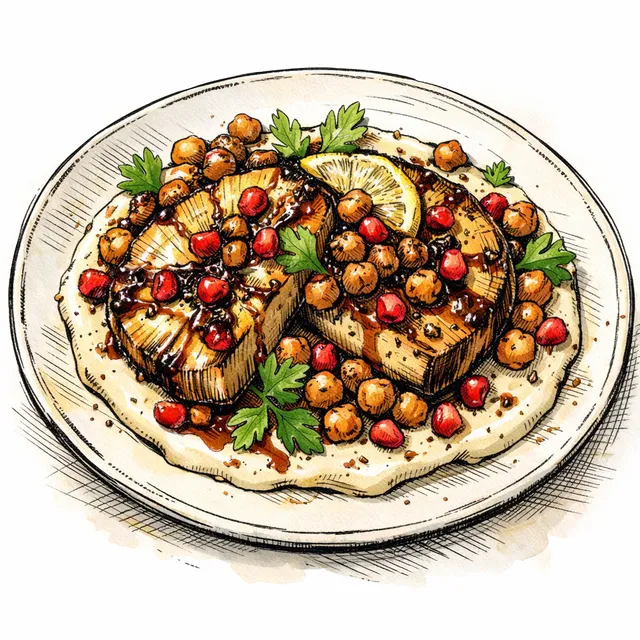
High-Heat Celeriac “Steaks”: A February Side That Refuses to Behave
February in London can feel like it’s been washed in dishwater, so I cook like I’m fighting back—high heat, loud flavors, and a plate that looks like it has somewhere to be. This recipe started as a craving for shawarma-shop drama, but without the meat: something caramelized, sliced thick, and absolutely drowning in sauces.
Celeriac is perfect for that. Back in Tel Aviv, my mum would send me to the market for “ugly vegetables” (her words, affectionate), and celeriac always looked like it had survived something. Blast it at high heat and it turns sweet, bronzed, almost steak-like at the edges.
What makes this dish mine is the layering: roasted garlic–tahini (because tahini belongs on everything), a sharp pomegranate-molasses glaze for that tangy pull, and then the crispy lemon–za’atar chickpea crunch—my non-negotiable texture chaos.
Make it yours: swap za’atar for dukkah, add chopped dates to the chickpeas, or finish with feta if you’re feeling Greek. And don’t be shy with herbs—more is always the answer.
Featured Recipe
High-Heat Celeriac “Steaks” with Roasted Garlic–Tahini, Pomegranate-Molasses Glaze & Crispy Lemon–Za’atar Chickpea Crunch
In February, I want a side dish that behaves like a centerpiece—deeply roasted, caramelized at the edges, and loud with sauces and crunch. These celeriac “steaks” get blasted at high heat until they’re bronzed and sweet, then I drown them in roasted garlic–tahini, a tangy pomegranate-molasses glaze, and a crispy lemon–za’atar chickpea crunch for that absolutely necessary texture chaos.
Save a copy to your collection for editing
Ingredients
- 2 medium (about 1.2–1.5 kg total) Celeriac (celery root), peeled(Cut into thick slabs; save trimmings for stock if you like)
- 4 tbsp Olive oil
- 2 tsp Kosher salt(plus more to taste)
- 1 tsp Black pepper
- 1 1/2 tsp Ground cumin
- 1 tsp Sweet paprika(or half sweet + half smoked if you like)
- 1 tsp Aleppo pepper(optional, for gentle heat)
- 2 Lemons(zest 1 lemon; juice both)
- 1 (400 g / 14 oz) can Canned chickpeas, drained and well dried(dry them aggressively for maximum crunch)
- 2 tsp Za’atar
- 1 tbsp Sesame seeds(optional but lovely for extra crunch)
- 1 Garlic head(for roasting)
- 1/2 cup Tahini(well-stirred)
- 1/2 cup Ice-cold water(plus more as needed to loosen sauce)
- 1/2 tsp Ground coriander
- 1 tbsp Honey or date syrup(optional, balances acidity)
- 2 tbsp Pomegranate molasses
- 1 tbsp Extra lemon juice(for the glaze)
- 1 tbsp Olive oil (for glaze)
- 1 cup Fresh herbs (parsley, dill, and/or mint)(roughly chopped—more herbs is always the answer)
- 1/3 cup Pomegranate arils(optional but very on-brand and gorgeous)
- from 1 lemon Lemon zest(Appears in crunchy topping but not listed separately.)
Instructions
- 1
Heat the oven to 240°C / 465°F (or 230°C / 445°F convection). Put a heavy sheet pan inside to preheat—this is how we get that instant sizzle and deep browning on celeriac.
10 min
Tip: If you only do one cheffy thing today, preheat the tray. It’s the difference between pale roast and bronzed edges.
- 2
Prep the celeriac: slice each peeled celeriac into 2–3 cm (about 1 inch) thick slabs (“steaks”). Toss with 2 1/2 tbsp olive oil, 1 1/2 tsp salt, pepper, cumin, paprika, and Aleppo (if using).
8 min
Tip: Don’t go thinner than 2 cm—celeriac needs thickness to stay creamy inside while the outside caramelizes.
- 3
Roast the garlic: slice the top off the 1 Garlic head, drizzle with a little olive oil, wrap in foil, and put it on the sheet pan corner (or directly on the oven rack).
1 min
Tip: Roasting the garlic turns the tahini sauce into something round and almost buttery without adding dairy.
- 4
Carefully pull out the hot sheet pan. Arrange celeriac slabs in a single layer. Roast 18 minutes, flip, then roast another 12–18 minutes until deeply browned and tender when pierced.
35 min
Tip: If the pan looks dry at flipping time, drizzle a tiny bit more oil around the slabs—not on top—so the surfaces stay dry and brown.
- 5
While the celeriac roasts, make the crunchy topping: toss canned chickpeas with 1 tbsp olive oil, 1/2 tsp salt, lemon zest, za’atar, and sesame seeds (if using). Spread on a second sheet pan and roast 18–25 minutes, shaking once, until crisp and blistered.
25 min
Tip: Dry chickpeas = crunch. I pat them with a towel, then let them air-dry 5 minutes while the oven heats.
- 6
Make the roasted garlic–tahini: squeeze the soft roasted garlic cloves into a bowl. Add tahini, juice of 1 lemon, coriander, 1/2 tsp salt, and (optional) honey/date syrup. Whisk, then stream in ice-cold water until it turns pale and silky—like thick cream.
8 min
Tip: Tahini seizes before it loosens—keep whisking and trust the process. Add water gradually to control thickness.
- 7
Make the pomegranate glaze: in a small bowl whisk pomegranate molasses, 1 tbsp lemon juice, and 1 tbsp olive oil. Taste—you're looking for sharp-sweet and glossy.
3 min
Tip: If your pomegranate molasses is very intense, add 1 tsp water or a touch more honey/date syrup.
- 8
Assemble like a winter mezze centerpiece: swoosh roasted garlic–tahini onto a platter. Stack celeriac “steaks” on top. Drizzle with pomegranate glaze. Shower with crispy chickpea crunch, fresh herbs, and pomegranate arils (if using). Finish with a final pinch of salt and a squeeze of lemon.
6 min
Tip: Layering matters: sauce first (so it hugs), then celeriac, then glaze, then crunch. This keeps the topping crisp.
Chef's Notes
This is my kind of side: it steals the show but plays well with anything—roast chicken if you’re not avoiding it, a simple grilled fish, or a pot of lentils. If you can’t find pomegranate arils in winter, don’t force it—just go heavier on herbs and lemon. Leftovers are excellent tucked into a pita with cucumbers and more tahini (because obviously).

Yael Mizrahi
Bold flavors, beautiful plates
Born in Tel Aviv to a Moroccan mother and Iraqi father, I grew up speaking the language of spice. My kitchen was always full of cumin, preserved lemons, and the sound of multiple conversations happening at once. I moved to London at 22, cooked my way through the city's best restaurants, and discovered that the whole Mediterranean was my playground. Now I create dishes that celebrate the entire region—from Marrakech to Athens, with plenty of stops in between.