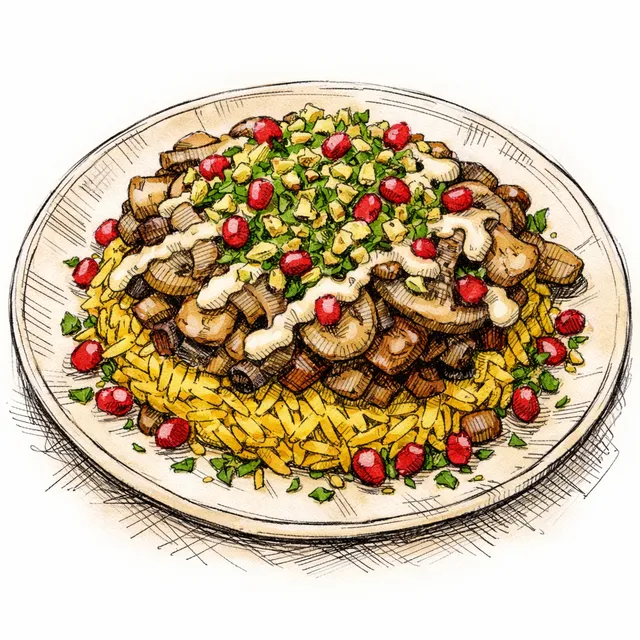
Jerusalem Artichoke & Mushroom Maqluba: Winter Comfort, Tel Aviv Brightness
January does something to me: I start craving dishes that feel like a duvet—warm, grounding, a little dramatic. Maqluba was always that dish in my orbit growing up in Tel Aviv: the flip at the table, the collective gasp, the way everyone suddenly has an opinion about the crispy bits.
This version came out of a London winter shop where Jerusalem artichokes looked too knobbly and charming to ignore. I pair them with mushrooms and really push the caramelization until the whole bottom layer turns almost meaty. That’s the soul of this maqluba—the deep, dark roastiness—then I crown it with saffron rice for perfume, and a lemon-pistachio gremolata because I’m incapable of serving anything without a bright, herb-heavy counterpunch.
And the pomegranate tahini? That’s my Tel Aviv-London love story in a sauce: nutty, tangy, a little sweet, and unapologetically generous.
Make it yours: swap pistachios for almonds, add chickpeas for extra heft, or tuck in fried onions for more crunch. Just don’t skip the herbs—more is always the answer.
Featured Recipe
Jerusalem Artichoke & Mushroom Maqluba with Saffron Rice, Lemon-Pistachio Gremolata, and Pomegranate Tahini
In January, I crave dishes that feel like a hug but still crackle with texture—this maqluba does exactly that. Earthy Jerusalem artichokes and mushrooms caramelize into a deep, almost meaty layer, then get flipped under a halo of saffron rice, bright herbs, and a tangy pomegranate tahini that I’d happily put on my breakfast toast.
Save a copy to your collection for editing
Ingredients
- 1 1/2 cups Basmati rice(rinsed until water runs mostly clear)
- 2 1/4 cups Hot water or vegetable stock(keep extra hot water nearby if needed)
- 1/2 tsp Saffron threads(or 1 tsp ground turmeric as a swap)
- 2 1/2 tsp Kosher salt(divided, plus more to taste)
- 450 g Jerusalem artichokes (sunchokes)(scrubbed; slice into 1 cm rounds)
- 350 g Mushrooms (cremini or mixed wild)(torn or thick-sliced)
- 1 Yellow onion(thinly sliced)
- 5 cloves Garlic(3 for the pot, 2 for the gremolata)
- 5 tbsp Extra-virgin olive oil(divided)
- 2 tbsp Unsalted butter(optional, but I love the richness here)
- 1 1/2 tsp Ground cumin
- 1 tsp Ground coriander
- 1/2 tsp Allspice(or cinnamon for a sweeter warmth)
- 1 tsp Aleppo pepper(plus more for serving)
- 1/2 tsp Black pepper(freshly ground)
- 1 Lemon(zest and 2 tbsp juice, divided)
- 1 cup Flat-leaf parsley(finely chopped)
- 1/2 cup Dill(finely chopped (or mint if that’s what you’ve got))
- 1/3 cup Pistachios(toasted, roughly chopped)
- 1 1/2 tbsp Pomegranate molasses(for the tahini sauce; substitute 1 tbsp honey + extra lemon if needed)
- 1/2 cup Tahini(well-stirred)
- 1/3 cup Cold water(plus more to thin)
- 1/2 cup Pomegranate arils(for topping (optional but gorgeous))
Instructions
- 1
Soak the rice. Put the rinsed 1 1/2 cups Basmati rice in a bowl, cover with cool water, and let it sit while you prep everything else.
15 min
Tip: This helps the grains stay long and separate—maqluba should slice cleanly, not slump.
- 2
Bloom the saffron. In a small cup, crush the 1/2 tsp Saffron threads with a pinch of salt, then pour in 3 tbsp Hot water or vegetable stock. Set aside.
5 min
Tip: If you’re using turmeric instead, skip blooming and just add it with the rice later.
- 3
Caramelize the base vegetables. In a large, heavy pot with a tight lid (about 24 cm/9–10 in), heat 3 tbsp Extra-virgin olive oil (and 2 tbsp Unsalted butter, if using) over medium-high. Add the 1 Yellow onion, chopped with a pinch of salt and cook until deeply golden, 8–10 minutes. Add the 450 g Jerusalem artichokes (sunchokes), peeled and cut and cook until they get bronzed edges, 6–8 minutes. Add 350 g Mushrooms (cremini or mixed wild), sliced and cook until they release liquid, then the liquid cooks off and everything goes dark and glossy, 8–10 minutes. Stir in 1 1/2 tsp Ground cumin, 1 tsp Ground coriander, 1/2 tsp Allspice, 1 tsp Aleppo pepper, 1/2 tsp Black pepper, and 3 cloves Garlic, grated; cook 30 seconds until fragrant.
30 min
Tip: Don’t rush the browning—this is the whole point of the flip. The more caramelization here, the more dramatic (and delicious) the top layer will be.
- 4
Drain and season the rice. Drain the rice well. In a bowl, toss it with 1 1/2 tsp Kosher salt, the saffron water (or turmeric), 1 tbsp Extra-virgin olive oil, and 1 tbsp Lemon juice.
3 min
Tip: Oil helps the grains stay distinct; lemon keeps the finished dish lifted, not heavy.
- 5
Build the maqluba. Level the mushroom-sunchoke layer in the pot. Spoon the rice over it evenly (don’t stir!), then pour in 2 1/4 cups Hot water or vegetable stock along the side of the pot. You want the liquid just to cover the rice by about 1 cm; add a splash more hot water if needed. Bring to a gentle boil, then immediately cover, reduce to low, and cook until the rice is tender and the liquid is absorbed.
25 min
Tip: Keep the heat low once covered—maqluba wants steady steam, not aggressive bubbling that breaks the layers.
- 6
Rest (this is non-negotiable). Turn off the heat and let the pot sit, covered, for 10 minutes.
10 min
Tip: This sets the structure so the flip comes out like a cake instead of a landslide.
- 7
Make the lemon-pistachio gremolata. In a bowl, combine 1 cup Flat-leaf parsley, chopped, 1/2 cup Dill, chopped, 1/3 cup Pistachios, chopped, 1 Lemon, zested, 2 cloves Garlic, grated, 1 tbsp Extra-virgin olive oil, and a pinch of salt. Taste and adjust with a squeeze of lemon if you want it sharper.
5 min
Tip: Herbs are the winter sunbeam here—be generous.
- 8
Whisk the pomegranate tahini. In another bowl, whisk 1/2 cup Tahini, 1 1/2 tbsp Pomegranate molasses, 1 tbsp Lemon juice, 1/3 cup Cold water, and 1/2 tsp Kosher salt until thick and glossy. Thin with a little more water until it ribbons off a spoon.
4 min
Tip: If it seizes up, don’t panic—just keep whisking and add water a tablespoon at a time.
- 9
Flip and finish. Run a knife around the edge of the pot. Place a large serving platter over the pot and, with confidence, flip. Lift the pot slowly. Shower with the gremolata and (if using) 1/2 cup Pomegranate arils. Serve with extra tahini sauce and a final pinch of Aleppo.
3 min
Tip: Confidence is an ingredient here. If a little sticks, just patch it—then cover it with herbs like we planned.
Chef's Notes
This dish is my January love letter to the markets—when everything looks a bit beige, you make it taste like fireworks. In Tel Aviv, I grew up on upside-down pots that arrived at the table like magic; in London winters, I learned to worship mushrooms and sunchokes for their deep, woodsy sweetness. If you can’t find Jerusalem artichokes, swap in parsnips or celeriac (same slicing, same caramelizing). Want it more festive? Add a handful of dried barberries or sour cherries into the rice before cooking for little pops of tartness.

Yael Mizrahi
Bold flavors, beautiful plates
Born in Tel Aviv to a Moroccan mother and Iraqi father, I grew up speaking the language of spice. My kitchen was always full of cumin, preserved lemons, and the sound of multiple conversations happening at once. I moved to London at 22, cooked my way through the city's best restaurants, and discovered that the whole Mediterranean was my playground. Now I create dishes that celebrate the entire region—from Marrakech to Athens, with plenty of stops in between.