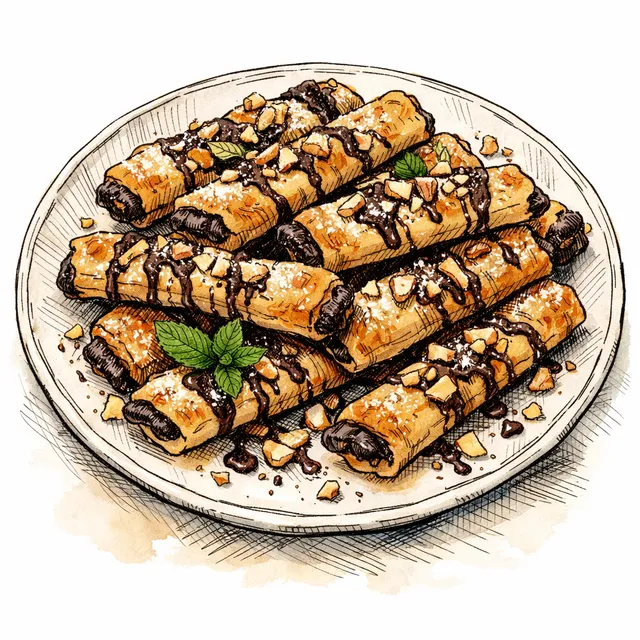
Roasted Hazelnut & Bittersweet Chocolate Rough-Puff Bâtonnets
We are not suffering for brunch, and we certainly aren't spending three days laminating butter just to satisfy a pastry craving. These Bâtonnets came out of a Tuesday night desperation for something café-level without the fuss. I wanted that shatteringly crisp, lacy crumb—not tight like a bad alibi—paired with the deep, earthy crunch of roasted hazelnuts and sharp bittersweet chocolate. Back in Paris, the boulangeries always had these little leftover scrap-pastry treats, but my Bay Area kitchen demands efficiency. By using a weeknight rough-puff that cuts lamination down to two quick turns, we keep all the flaky lift with zero of the drama. Butter is not a garnish here, so use the good stuff. Toss in some fresh orange zest to wake up the chocolate, and let time do the work in the fridge. Cami's shortcut note: keep your butter cold and your hands quick. Don't skip the flaky salt on top—it bridges the rich nuts and the dark cocoa. If your kitchen runs warm, pop the dough back in the fridge. Let time do the work, and bake until deeply golden.
Featured Recipe
Roasted Hazelnut & Bittersweet Chocolate Rough-Puff Bâtonnets
Shatteringly crisp, lacy pastry batons layered with deeply toasted hazelnuts, chopped dark chocolate, and orange zest. These café-style snack sticks rely on a weeknight rough puff that cuts lamination down to two quick turns without losing an ounce of lift.
Save a copy to your collection for editing
Timeline
Ingredients
- 250 g unbleached all-purpose flour(about 2 cups, chilled in the freezer for 10 minutes)
- 200 g unsalted cultured butter(about 14 tbsp, very cold and cut into 1/2-inch cubes)
- 1 tsp fine sea salt
- 100 ml ice water(about 6 to 7 tbsp, strained of ice cubes)
- 140 g whole roasted hazelnuts(about 1 cup, skinned and coarsely chopped)
- 50 g turbinado sugar(about 1/4 cup, divided)
- 70 g 70% bittersweet chocolate(finely chopped into gravel-sized flecks)
- 1 tsp orange zest(freshly grated)
- 1 large egg(beaten with 1 tsp water for egg wash)
- 0.5 tsp flaky sea salt(such as Maldon, for finishing)
Instructions
- 1
Prep the hazelnut filling. In a small bowl, toss 100 g whole roasted hazelnuts (save the remaining for the finish) with 35 g turbinado sugar, 70 g 70% bittersweet chocolate, and 1 tsp orange zest. Set aside in a cool spot so the chocolate doesn't melt.
5 min
Tip: Chop the chocolate into coarse rubble rather than dust; fine powder will muddy the layers, but distinct flecks melt into pockets of ganache inside the pastry.
- 2
Make the base rough puff. In a large wide mixing bowl, whisk 250 g unbleached all-purpose flour and 1 tsp fine sea salt. Toss in 200 g unsalted cultured butter until every cube is coated in flour. Using your thumbs and pointer fingers, press each butter cube flat into a broad coin—do not rub them down into cornmeal. Butter is not a garnish; keeping large, flat sheets of butter is what generates steam pockets.
5 min
Tip: Work fast. If the butter feels sticky or softens past room temperature, throw the entire bowl in the freezer for 5 minutes.
- 3
Drizzle 100 ml ice water around the edge of the flour bowl. Use a silicone bench knife or your hand like a claw to gently toss until a shaggy, dry dough forms with visible flour patches. Tip out onto a lightly floured board and pat firmly into a rough 6x8-inch rectangle.
5 min
Tip: It will look under-hydrated and crumbly. Do not add extra water; the moisture hydrates evenly during the rolls and refrigeration.
- 4
Execute Turn 1. Roll the dough into a 8x16-inch rectangle, keeping the edges square. Fold the top third down and the bottom third up like a business letter (a tour simple). Turn the dough 90 degrees.
5 min
Tip: Use the side of your rolling pin to tap the edges straight before rolling so you maintain clean corners.
- 5
Laminate the filling during Turn 2. Roll the dough out again to roughly 8x18 inches. Scatter the hazelnut-chocolate mixture evenly across the middle two-thirds of the dough. Fold the bottom third up over the center, then the top third down. Gently press with the rolling pin to lock the layers, wrap in parchment, and chill in the refrigerator for 20 minutes.
25 min
Tip: Don't panic if a hazelnut pierces the dough surface slightly—this rough lamination trap is forgiving and bakes into a caramelized brittle on the baking sheet.
- 6
While the dough rests, position an oven rack in the center and preheat the oven to 400°F (200°C). Line a heavy rimmed half-sheet pan with parchment paper.
15 min
Tip: A ripping hot oven ensures instant butter steam before the fat melts and runs out.
- 7
Roll the chilled dough on a lightly floured surface into a clean 10x12-inch rectangle, about 1/4-inch thick. Trim 1/8 inch off the perimeter using a sharp chef's knife or pastry wheel to expose the lacy lamination. Cut the sheet crosswise into 12 even bâtonnets (approx 1x10 inches each).
7 min
Tip: Slice straight down in one firm cut; dragging the knife pinches the delicate butter layers closed and stunts the rise.
- 8
Transfer the strips to the prepared baking sheet, leaving 1.5 inches of space between them. Lightly brush the tops of the bâtonnets with 1 large egg wash. Scatter remaining 40 g whole roasted hazelnuts, the remaining 15 g turbinado sugar, and 0.5 tsp flaky sea salt evenly across the tops, pressing gently to adhere.
5 min
Tip: Avoid letting egg wash drip down the cut sides, which can weld the pastry sheets together.
- 9
Bake at 400°F (200°C) for 22 to 25 minutes, rotating the pan front-to-back at the 14-minute mark. Look for a deep hazel-brown shade on the pastry ridges, bubbling chocolate blisters, and dry, puffed edges that lift cleanly.
25 min
Tip: Color is flavor here. Pale rough puff tastes doughy; bake until it reaches a deep, glossy mahogany.
- 10
Slide the parchment with the bâtonnets onto a wire cooling rack. Let cool undisturbed for at least 10 minutes so the caramel and molten chocolate set before serving.
10 min
Tip: If you eat them straight from the pan, they will feel soft; the iconic crunch develops as the pastry cools and the butter firms back up.
Chef's Notes
Cami’s shortcut note: Traditional feuilletage takes six turns and three hours of waiting. Here, we laminate the roasted hazelnut praline mix directly into the second letter fold. It acts like an edible friction brake, holding open the butter layers and ensuring high, crisp flakes in a fraction of the time. Don’t skip this: Buy skinless whole hazelnuts and give them a hard toast until deeply fragrant before chopping, or toast them in a dry skillet until dark amber. Pale hazelnuts bring zero café drama.

Camille Roux
Café-level bakes, weeknight methods, zero compromise.
Camille “Cami” Roux was born in Paris with flour in her hair and a healthy skepticism of culinary dogma. She grew up around neighborhood boulangeries that treated crust and crumb like religion—but what stuck with her wasn’t rigid tradition. It was the quiet precision: good butter that actually tastes like milk, patient fermentation that builds flavor for free, and desserts that know when to stop before they get cloying. After moving to the Bay Area, Cami trained in a bread-and-pastry scene obsessed with texture, naturally leavened doughs, and seasonal fruit—Tartine energy, minus the martyrdom. She became known for loaves that sing when they cool, jammy tarts with clean edges, and “how is this so good?” weeknight pastries made with a few smart shortcuts. Her motto is high impact, low fuss: splurge where it counts (butter, salt, time), streamline the rest (sheet pans, one bowl, cold-proofing). If it doesn’t improve flavor or structure, it doesn’t earn a step.