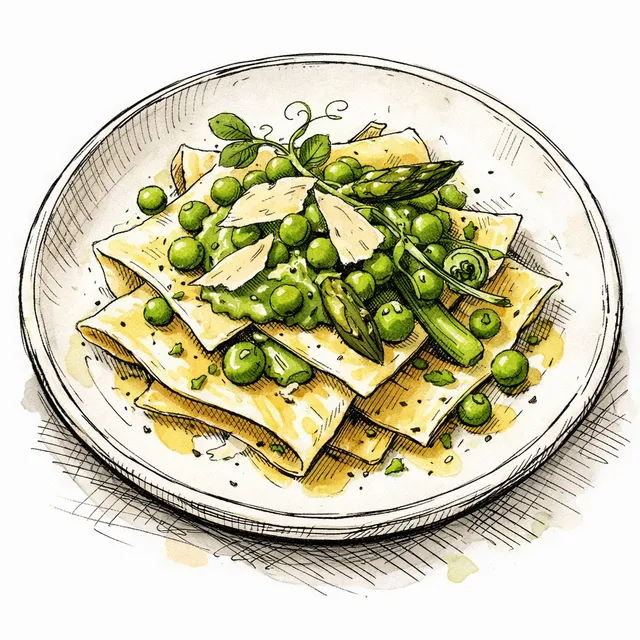
The Emerald Cantilever: Open-Faced Spring Pea Fazzoletti
Architecture and pasta share a fundamental truth: a beautiful structure requires a solid foundation. Growing up, spring in my grandmother's Piedmontese kitchen meant hours of shelling peas and layering intricate baked pastas. Today, my fast-paced Milanese life demands a brilliant shortcut. Enter The Emerald Cantilever: Open-Faced Spring Pea Fazzoletti. Think of this dish as a deconstructed lasagna where the structural integrity of every layer is fully visible. We use fresh store-bought pasta sheets as our foundational slabs, layered openly with vibrant, lightly smashed spring peas. The mortar holding our cantilever together? A load-bearing dollop of rich mascarpone fortified with a sharp dry vermouth reduction. I measure the mascarpone purely by eye, roughly the volume of a standard brass doorknob. It is a stunning visual homage to nonna's slow-simmered flavors, engineered for a busy Tuesday. What makes this recipe so special to me is its honest transparency; there is nowhere for subpar components to hide. To make it your own, consider the garnish as your decorative facade: a shower of robust Parmigiano-Reggiano or crispy fried fresh sage leaves adds perfect textural contrast. Remember, just let the ingredients do the heavy lifting, because weeknight cooking should feel like an escape, not a chore.
Featured Recipe
The Emerald Cantilever: Open-Faced Spring Pea Fazzoletti
Think of this dish as a deconstructed lasagna where the structural integrity of every layer is fully visible. We use fresh pasta sheets—our foundational slabs—layered openly with vibrant, lightly smashed spring peas, a sharp vermouth reduction, and a load-bearing mascarpone mortar. It is an elegant, modern homage to my grandmother's springtime kitchen in Piedmont, built for the pace of a Milanese weeknight.
Save a copy to your collection for editing
Timeline
Ingredients
- 8 oz Fresh pasta sheets (lasagna sheets)(Store-bought is perfectly fine; cut into 4-inch squares to create our 'fazzoletti' (handkerchiefs).)
- 1.5 cups Fresh or frozen spring peas(Thawed if frozen. Our architectural hero.)
- 1/2 cup Mascarpone cheese(Room temperature, to act as our structural mortar.)
- 1/4 cup Parmigiano-Reggiano(Freshly grated, plus more for the facade.)
- 2 tbsp Unsalted butter(For building our aromatic fat base.)
- 6 leaves Fresh sage leaves
- 1 whole Shallot(Thinly sliced.)
- 1/4 cup Dry vermouth(The sharp acid that cuts through the rich dairy.)
- 1/3 cup Premium store-bought chicken brodo(Vegetable brodo works beautifully as well.)
- 1 whole Lemon(Zested, for the mortar.)
- 1 tsp lemon zest(zest from 1 whole lemon)
- to taste black pepper
Instructions
- 1
Set 4 quarts water to boil in a large pot with a heavy pinch of salt. This rolling boil will be the rapid-fire liquid foundation for cooking our fazzoletti.
10 min
Tip: Always cover the pot to bring the water to a boil faster; weeknight cooking is an exercise in efficiency.
- 2
While the water heats, vigorously whip 1/2 cup mascarpone cheese with 1/4 cup Parmigiano-Reggiano and 1 tsp lemon zest in a small bowl. Season with a pinch of salt and black pepper. This is our mortar—it provides load-bearing richness between the pasta layers.
3 min
Tip: If the mascarpone is too stiff, add a tiny splash of warm water to loosen it into a spreadable consistency.
- 3
Melt 2 tbsp unsalted butter in a wide, heavy-bottomed skillet over medium heat. Add 1 thinly sliced shallot and 6 fresh sage leaves. Sauté until the shallot softens and the sage becomes crisp, building a deeply aromatic base.
4 min
Tip: Keep an eye on the butter so the milk solids toast but do not burn.
- 4
Pour in 1/4 cup dry vermouth to deglaze the pan, letting the alcohol evaporate for about a minute. Then, stir in 1.5 cups spring peas and 1/3 cup premium store-bought chicken brodo. Simmer vigorously until the peas are bright and tender.
5 min
Tip: Once tender, use the back of a wooden spoon to gently crush about half of the peas. This creates structural variation and helps the mixture cling to the slick pasta.
- 5
Drop the 8 oz fresh pasta sheets (cut into 4-inch squares) into the boiling salted water. Fresh pasta cooks in a flash—drain them carefully with a spider or slotted spoon after just 90 seconds, reserving a few tablespoons of the starchy water.
2 min
Tip: Do not rinse the pasta; the residual starch is critical for adhering to our mascarpone mortar.
- 6
To assemble, lay a single hot pasta square on each warm plate. Spread a dollop of the mascarpone mortar, top with the braised pea mixture, and drape another pasta square over it like a cantilevered roof. Garnish with a final spoonful of peas, the crispy sage, and an extra shower of Parmigiano.
3 min
Tip: Work quickly during assembly so the heat of the pasta gently melts the mascarpone into a makeshift sauce. Let the ingredients do the heavy lifting.
Chef's Notes
My grandmother would have spent hours shelling fresh peas and laminating egg dough by hand. While I deeply respect that tradition, modern architecture requires modern materials. Using high-quality store-bought fresh pasta and a rapid vermouth reduction captures the soul of spring in Northern Italy without keeping you tethered to the stove on a Tuesday evening.

Elena Rossi
Effortless Northern Italian elegance for busy modern weeknights.
Milan-born Elena Rossi, her true passion was always simmering on the stove. Raised on the rich, comforting flavors of her grandmother's Piedmontese kitchen, Elena found herself constantly reimagining those time-intensive classics for her own demanding, fast-paced lifestyle. Today, Elena is the voice behind a beloved culinary movement that proves authentic Italian food does not require spending eight hours stirring a pot. She beautifully merges the precision of her design background with the soul of Northern Italian cooking, offering busy home cooks a stylish, stress-free approach to dinner. Whether she is utilizing a pressure cooker for a Tuesday night osso buco or elevating a high-quality store-bought brodo with fresh herbs, Elena empowers her readers to cook with confidence. Her recipes are a testament to the idea that practicality and elegance can perfectly coexist on the modern dinner table.