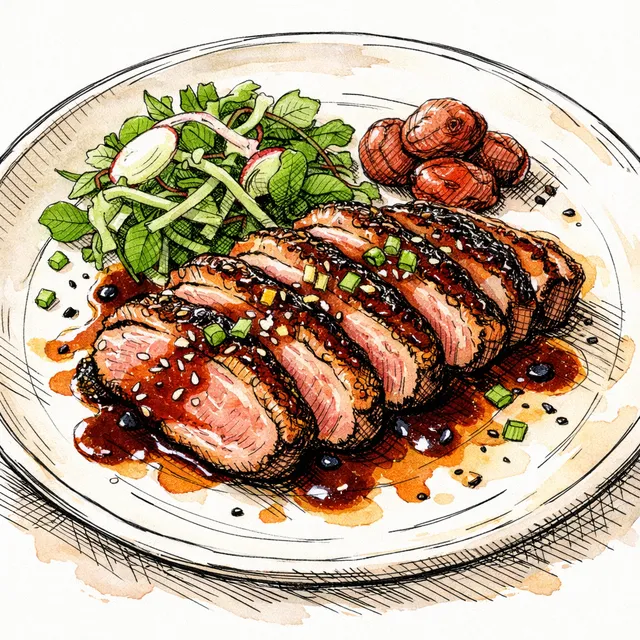
Cold-Seared Duck Breast with Ancho-Umeboshi Glaze: A Tokyo-Oaxaca Mashup
Izakaya food is all about aggressive, savory bites that stand up to a cold beer. I wanted to take the lacquered, smoky vibe of yakitori and apply it to a whole duck breast. The inspiration hit me during a late-night street food crawl in Oaxaca. I was eating a rich duck taco with a dark chile salsa, and suddenly I missed the tart, salty punch of umeboshi from my days training in Tokyo. I realized the sweet, raisiny depth of Mexican ancho chile would perfectly collide with Japanese pickled plum! Why does this work? Duck fat is luscious but heavy. The ancho brings earthy warmth, while the umeboshi acts as an astringent blade, slicing right through the richness. I use a cold-sear technique here. Starting the duck breast in a cold pan slowly renders the fat without seizing the meat, giving you perfectly crispy skin and a tender, medium-rare center. Make it your own: swap the ancho for guajillo if you want more fruitiness, or fold a spoonful of this glaze into some fermented gochujang. Have fun with it, break the rules, and make sure your beer is ice cold!
Featured Recipe
Cold-Seared Duck Breast with Ancho-Umeboshi Glaze
Izakaya food is all about aggressive, savory bites that stand up to a cold beer or a stiff highball. I wanted to take the lacquered, smoky vibe of yakitori and apply it to a whole duck breast. We're crossing borders here: the sweet, raisiny depth of Mexican ancho chile collides with the tart, salty punch of Japanese umeboshi (pickled plum). It cuts right through the rich duck fat.
Save a copy to your collection for editing
Timeline
Ingredients
- 2 whole duck breasts(About 6 oz each, patted completely dry)
- 1 tsp kosher salt(For seasoning the meat side)
- 0.5 tsp black pepper(Freshly ground)
- 2 tbsp umeboshi paste(Japanese pickled plum paste; find it at Asian grocers)
- 1 tbsp ancho chile powder(Do not substitute standard chili powder; you want the raisiny sweetness of pure ancho)
- 3 tbsp mirin(Sweet Japanese cooking wine)
- 1 tbsp soy sauce(Preferably a dark or aged shoyu)
- 1 tbsp honey(To balance the acidity and help lacquer the glaze)
- 2 bunches spring onions(Trimmed, white and light green parts only. Scallions work if spring onions aren't in season.)
- 1 tbsp toasted sesame seeds(For garnish)
- 1 tbsp duck fat(Mentioned in step 7, but not in ingredient list. Used to sear spring onions.)
Instructions
- 1
Using a sharp knife, gently score the skin of 2 whole duck breasts in a crosshatch pattern, spacing the cuts about 1/2-inch apart. Be careful not to cut into the flesh. Season the flesh side only with 1 tsp kosher salt and 0.5 tsp black pepper.
5 min
Tip: Scoring the skin gives the fat a way to escape during cooking, guaranteeing a crispy finish.
- 2
Place the scored duck breasts skin-side down in a cold, dry skillet (cast iron or carbon steel preferred). Turn the heat to medium-low. Let the fat slowly render out for 15 minutes, pouring off the excess fat into a heatproof bowl halfway through.
15 min
Tip: Starting in a cold pan is non-negotiable. If you drop duck into a hot pan, the meat cooks before the thick layer of fat has time to render and crisp.
- 3
While the duck fat renders, whisk together 2 tbsp umeboshi paste, 1 tbsp ancho chile powder, 3 tbsp mirin, 1 tbsp soy sauce, and 1 tbsp honey in a small bowl until smooth.
5 min
Tip: Taste this glaze! It should aggressively ping your palate—salty, sour, sweet, and a little smoky.
- 4
Wash and trim 2 bunches spring onions, leaving them whole but removing the dark green tops (save those for stock) and root ends.
5 min
Tip: Pat them completely dry so they sear rather than steam in the duck fat.
- 5
Once the duck skin is deeply golden and crispy, flip the breasts over. Cook the flesh side for 3 minutes for a perfect medium-rare (internal temp around 130°F).
3 min
Tip: Duck breast should be served pink. If you prefer medium, add another 2 minutes.
- 6
Transfer the duck breasts to a cutting board to rest.
10 min
Tip: Resting allows the muscle fibers to relax and reabsorb their juices. Do not skip this.
- 7
Pour off all but about 1 tbsp duck fat from the skillet (save the rest in your fridge!). Turn the heat up to medium-high. Add the trimmed spring onions and sear, tossing occasionally, for 5 minutes until nicely charred. Transfer to a serving platter.
5 min
Tip: Spring onions cooked in duck fat are a revelation. Let them blister and pick up some of that fond.
- 8
Reduce the skillet heat to low. Pour in the glaze mixture. Let it bubble and reduce for 3 minutes until it thickens into a glossy, syrupy glaze.
3 min
Tip: Keep stirring to prevent the honey and mirin from burning.
- 9
Using a pastry brush, paint the resting duck skin heavily with about half of the thickened glaze.
2 min
Tip: Glazing off the heat ensures the sugars don't scorch while giving the duck a beautiful lacquered finish.
- 10
Slice the duck breasts crosswise into 1/2-inch thick pieces. Fan the slices out over the charred spring onions. Drizzle with the remaining glaze and sprinkle with 1 tbsp toasted sesame seeds.
2 min
Tip: Serve immediately while the skin is crispy and the center is warm and juicy.
Chef's Notes
Here's the science on why this works: Duck breast carries a massive cap of fat. If you drop it into a hot pan like a steak, the meat will overcook long before the fat crisps. By starting in a cold pan, we trick the fat into slowly melting away, leaving behind a wafer-thin, chicharron-like crust. The glaze is where the magic happens: umeboshi is fiercely sour and salty, which we need to cut the richness of the duck fat, while the ancho provides a mellow, sweet, raisiny backbone that bridges the gap between Japanese Izakaya and Mexican cantina.

Kenji Nakamura
Where Japanese precision meets global flavors
I trained in Tokyo for eight years, mastering the discipline of washoku—traditional Japanese cuisine. But I got restless. So I cooked my way through Southeast Asia, spent a year in Mexico City, and fell hard for the food of Peru. Now I see connections between cuisines that others miss: the umami in dashi and fish sauce, the heat in shishito and Szechuan peppercorns, the way Japanese technique can unlock flavors from any tradition. I'm always fermenting something.