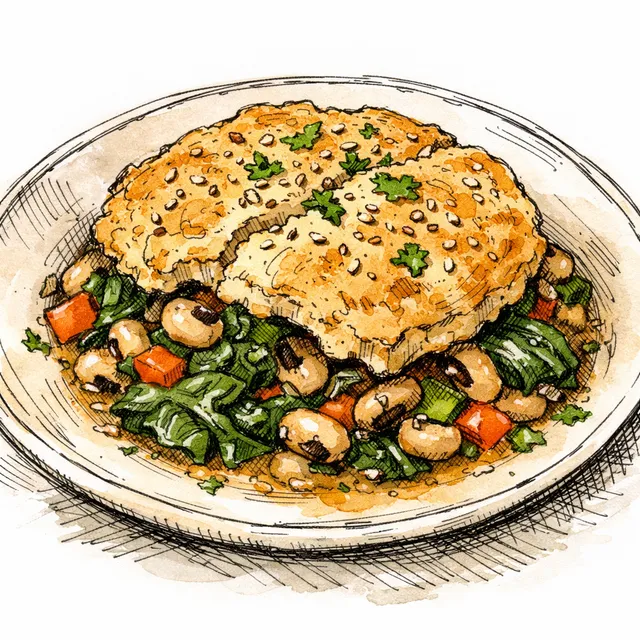
Black-Eyed Pea & Winter Greens Pot Pie with Benne Seed Biscuit Crust
January always pulls me back to the pot—something humble that bubbles all afternoon and makes the house smell like somebody’s taking care of you. This Black-Eyed Pea & Winter Greens Pot Pie started as a plain old peas-and-greens supper, the kind my grandmother in Atlanta could stretch for days. But after years in Charleston fine dining kitchens, I couldn’t help myself: I wanted that same comfort dressed up like Sunday—glossy gravy, a little edge, and a lid worth fighting over.
The inspiration is simple: New Year’s black-eyed peas for luck, winter greens for strength, and a biscuit on the side—except I bake the biscuit right on top and let it turn crackly and golden. Benne seeds (that old Lowcountry sesame) toast up nutty and fragrant, like a whisper from the coast.
What makes it special to me is the way it bridges my worlds: my grandmother’s thrift and tenderness, and my chef’s instinct to build deep flavor. I sneak in a splash of fish sauce or a dash of vinegar at the end—just enough to make the gravy sing.
Make it yours: use collards, mustard, kale—whatever looks tough and proud. Add smoked turkey, ham hock, or keep it meatless and go heavy on black pepper and hot sauce. And don’t skimp on the benne seeds; that crust is the whole love letter.
Featured Recipe
Black-Eyed Pea & Winter Greens Pot Pie with Benne Seed Biscuit Crust
This is my January kind of comfort: a humble pot of peas and greens, dressed up like Sunday supper and tucked under a crackly benne-seed biscuit crust. It eats like a pot pie, but the soul is pure Southern—earthy legumes, silky winter greens, and a savory, glossy gravy with just enough modern edge to keep you leaning in for the next bite.
Save a copy to your collection for editing
Ingredients
- 1 lb Dried black-eyed peas(picked over and rinsed)
- 2 1/2 tsp Kosher salt(plus more to taste)
- 1 Smoked ham hock(or 6 oz smoked turkey wing; optional but recommended)
- 2 Bay leaves
- 1 large Yellow onion(diced)
- 2 stalks Celery(diced)
- 2 medium Carrots(diced)
- 5 cloves Garlic(minced)
- 1 tbsp Tomato paste
- 3 tbsp All-purpose flour(for thickening)
- 4 cups Chicken stock(low-sodium)
- 3 cups Water(plus more if needed)
- 6 sprigs Fresh thyme(or 1 tsp dried thyme)
- 1 sprig Fresh rosemary(optional but nice)
- 1 1/2 tbsp Apple cider vinegar(to brighten)
- 1 tsp Fish sauce(my quiet little booster; optional but highly recommended)
- 1/2 tsp Freshly ground black pepper(plus more to taste)
- 6 oz Lacinato kale(stems removed, chopped (about 4 packed cups))
- 6 oz Collards(thinly sliced (about 4 packed cups))
- 3 tbsp Unsalted butter(divided)
- 1 tsp Hot sauce(or to taste)
- 1 tsp Lemon zest(optional, for a winter-lift finish)
- 2 cups All-purpose flour (for biscuit crust)(plus more for dusting)
- 1 tbsp Baking powder (for biscuit crust)
- 1/2 tsp Baking soda (for biscuit crust)
- 1 tbsp Sugar (for biscuit crust)(just enough to round the smoke and greens)
- 1 1/4 tsp Kosher salt (for biscuit crust)
- 6 tbsp Cold unsalted butter (for biscuit crust)(cubed)
- 3/4 cup Cold buttermilk (for biscuit crust)(plus 1–2 tbsp if needed)
- 3 tbsp Toasted benne seeds (sesame)(plus 1 tsp for topping)
- 1 tbsp Melted butter (for topping)
- 1/4 tsp Flaky salt (for topping)(optional)
Instructions
- 1
Soak the peas (optional but helpful). Put 1 lb Dried black-eyed peas in a bowl, cover with cold water by 3 inches, and soak 6–12 hours. Drain and rinse. If you didn’t soak, no shame—just expect a little longer simmer and add water as needed.
10 min
Tip: In January I’m chasing comfort, not perfection. A soak makes the cook more even, but black-eyes are forgiving.
- 2
Build the smoky pea base. In a Dutch oven, combine drained peas, 1 Smoked ham hock, 2 Bay leaves, 4 cups Chicken stock, and 3 cups Water. Bring to a boil, then reduce to a steady simmer, partially covered, until peas are tender but not blown out.
45 min
Tip: Unsoaked peas may take 60–75 minutes. Keep them just submerged—add hot water if the level drops too low.
- 3
Sauté the winter trinity. In a separate skillet (or in a second pot if you’ve got it), melt 3 tbsp Unsalted butter over medium heat. Add 1 large Yellow onion, 2 stalks Celery, and 2 medium Carrots with 2 1/2 tsp Kosher salt. Cook until softened and sweet, then add 5 cloves Garlic and 1 tbsp Tomato paste and cook 1 minute.
12 min
Tip: That little bit of tomato paste is my Charleston training showing up—just enough to deepen the gravy without tasting ‘tomato.’
- 4
Make the gravy backbone. Sprinkle 3 tbsp All-purpose flour over the vegetables and cook 1–2 minutes, stirring. Ladle in about 1 cup of hot pea cooking liquid (or stock) and whisk until smooth. Pour this thickened mixture back into the pea pot. Add 6 sprigs Fresh thyme and 1 sprig Fresh rosemary.
5 min
Tip: Cooking the flour briefly keeps the filling from tasting raw and gives you that pot-pie gloss.
- 5
Season with my modern Southern “spark.” Stir in 1 1/2 tbsp Apple cider vinegar, 1 tsp Fish sauce, 1/2 tsp Freshly ground black pepper, and 1 tsp Hot sauce. Simmer 10 minutes so it all marries.
10 min
Tip: The fish sauce won’t read as fish—just deeper hammy, roasted, long-simmered flavor.
- 6
Add the greens at the right moment. Stir in 6 oz Lacinato kale and 6 oz Collards and simmer until tender and silky.
12 min
Tip: Adding greens late keeps their color and keeps the whole dish from tasting tired.
- 7
Finish the filling and set the oven. Remove ham hock, shred the meat, and return it to the pot (discard skin/bone). Taste and adjust salt. Stir in remaining 1 tbsp Unsalted butter and (optional) 1 tsp Lemon zest. Preheat oven to 425°F.
10 min
Tip: That last butter is my grandmother’s trick—she’d say it ‘makes it taste like you meant it.’
- 8
Make the benne biscuit crust. In a bowl, whisk 2 cups All-purpose flour (for biscuit crust), 1 tbsp Baking powder (for biscuit crust), 1/2 tsp Baking soda (for biscuit crust), 1 tbsp Sugar (for biscuit crust), 1 1/4 tsp Kosher salt (for biscuit crust), and 3 tbsp Toasted benne seeds (sesame). Cut in 6 tbsp Cold unsalted butter (for biscuit crust) until you’ve got pea-size pieces. Pour in 3/4 cup Cold buttermilk (for biscuit crust) and stir just until a shaggy dough forms.
10 min
Tip: Stop mixing the second the flour disappears. Tender biscuits come from restraint.
- 9
Assemble. Pour filling into a 9x13-inch baking dish or a deep 3-quart casserole. Pat biscuit dough into an even slab about 3/4-inch thick (or drop in big rustic rounds) and lay over the top. Brush with 1 tbsp Melted butter (for topping) and sprinkle with remaining benne seeds (and 1/4 tsp Flaky salt (for topping) if you like).
10 min
Tip: If your filling is very thick, loosen with a splash of stock—pot pie should spoon, not stand.
- 10
Bake until the top is proud and bronzed and the edges are bubbling. Rest before serving so the gravy sets slightly.
22 min
Tip: If the top browns too fast, tent loosely with foil for the last 5–8 minutes.
Chef's Notes
January always makes me think about the foods that carried folks through: peas, greens, and whatever smoke you had to flavor the pot. My grandmother in Atlanta cooked black-eyed peas more often than just New Year’s—because thrift and tradition don’t take seasons off. This pot pie is my way of putting that heritage in a new outfit: the same honest filling, but crowned with a benne-seed biscuit crust as a nod to the Lowcountry and the older West African thread benne carries with it. Serve it with a crunchy vinegar slaw if you want balance, or just a spoon and some quiet.

Marcus Stone
Heritage recipes with a chef's touch
My grandmother's kitchen in Atlanta is where I learned that food carries history. Every pot of collards, every batch of biscuits, every Sunday roast told stories of resilience, family, and love. I went on to train at the finest restaurants in Charleston and worked my way up through white-tablecloth kitchens. But I always came back to those family recipes—now I cook them with a chef's technique but a grandmother's heart. Because the best food honors where it came from.