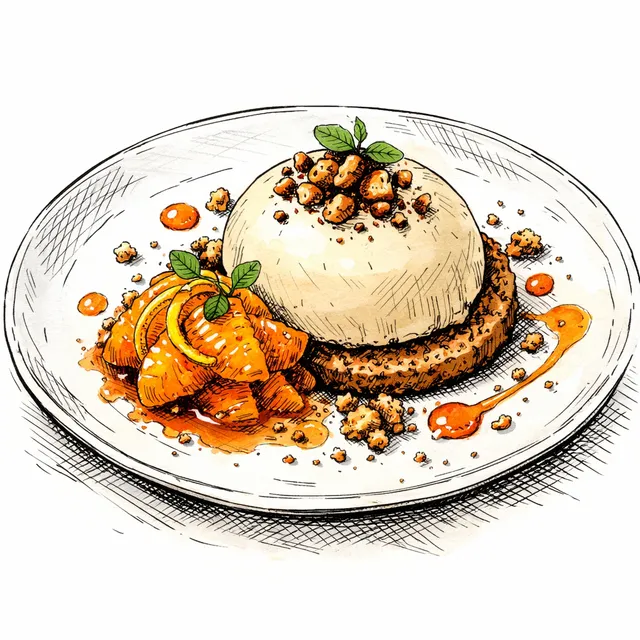
Cold-Infused Roasted Chestnut Bavarois with Tart Satsuma Confit & Brown Butter Sablé
Autumn demands cozy flavors, but I wanted something with clean lines. While burning out in fine-dining kitchens, heavy nut desserts always felt muddled. One November, while clearing out leftover roasted chestnuts from a tasting menu test, I wondered what would happen if we treated them like tea. By cold-steeping the roasted chestnuts into dairy overnight, we extract pure, mellow sweetness without any starchiness or bitterness. Precision is freedom, after all. Paired with a shatteringly crisp brown butter sablé base and the sharp, floral acidity of quick satsuma confit, every bite delivers calibrated contrast. Contrast is the secret ingredient. We are not adding steps—just improving decisions. Make it your own by swapping the satsuma for yuzu if you prefer a sharper punch of citrus. Let it chill properly. Future you deserves clean slices.
Featured Recipe
Cold-Infused Roasted Chestnut Bavarois with Tart Satsuma Confit & Brown Butter Sablé
An autumn study in temperature and texture: cold-steeping roasted chestnuts into dairy extracts pure, mellow sweetness without starchiness or bitterness. Paired with a shatteringly crisp brown butter sablé base and the sharp, floral acidity of quick satsuma confit, every bite delivers clean, calibrated contrast.
Save a copy to your collection for editing
Timeline
Ingredients
- 200 g roasted peeled chestnuts(roughly crushed; vacuum-packed or freshly roasted)
- 300 g whole milk(cold, for infusion)
- 300 g heavy cream(chilled, divided into 100g for base and 200g for whipping)
- 5 g sheet gelatin(silver strength (about 2.5 sheets), bloomed in ice water)
- 60 g large egg yolks(approx. 3 yolks, room temperature)
- 95 g granulated sugar(divided: 45g for bavarois, 25g for crust, 25g for satsuma confit)
- 2 g fine sea salt(divided: 1g for sablé crust, 1g for bavarois custard)
- 75 g unsalted butter(browned and cooled to room temperature)
- 90 g all-purpose flour(for sablé crust)
- 3 satsuma mandarins(zested and segmented; unpeeled weight approx. 300g)
- 10 g fresh lemon juice(to brighten the citrus confit)
- 1 g flaky sea salt(Maldon or similar, for finishing)
- 100 g heavy cream(Used in step 1 for cold-steeping.)
- 25 g granulated sugar(Used in step 2 for the sablé dough.)
- 1 g fine sea salt(Used in step 2 for the sablé dough.)
- 45 g granulated sugar(Used in step 5 for the custard base.)
- 1 g fine sea salt(Used in step 5 for the custard base.)
- 25 g granulated sugar(Used in step 7 for the confit.)
Instructions
- 1
In a clean glass container, combine 200 g roasted peeled chestnuts, 300 g whole milk, and 100 g heavy cream. Cover tightly, label with painter's tape, and chill in the refrigerator for 12 to 24 hours. Cold-steeping extracts deep, toasted nut aromatics without pulling heavy, starchy cloudiness into the dairy.
5 min
Tip: Crush the chestnuts coarsely with your fingers or a rolling pin before submerging to maximize surface contact.
- 2
Preheat your oven to 175°C (350°F). Line an 8-inch square metal baking pan with parchment paper, leaving a 2-inch overhang on opposing sides. In a small bowl, mix 75 g unsalted butter (browned and cooled), 90 g all-purpose flour, 25 g granulated sugar, and 1 g fine sea salt until a damp, sandy dough forms.
8 min
Tip: Brown the butter ahead of time until hazelnut-brown, then let it solidify slightly to room temperature so the crust doesn't weep oil.
- 3
Press the sablé dough evenly into the bottom of the prepared pan using the flat base of a measuring cup. Dock all over with a fork. Bake at 175°C for 14 to 16 minutes until golden brown and dry to the touch. Remove and allow to cool completely on a wire rack.
16 min
Tip: A firm, even press guarantees a clean, level slice later without crumbly breakage.
- 4
Submerge 5 g sheet gelatin in a bowl of ice-cold water to bloom for 5 minutes. Strain the cold-infused dairy through a fine-mesh sieve into a medium saucepan, pressing gently on 200 g roasted peeled chestnuts with a flexible spatula to extract the infused liquid (you should have about 320g of chestnut cream), then discard the solids.
6 min
Tip: Do not squeeze the chestnut solids violently; gentle pressing keeps the custard clean and silky instead of mealy.
- 5
Warm the strained chestnut dairy over medium-low heat until steaming (approx. 70°C). In a separate heatproof bowl, whisk together 60 g large egg yolks, 45 g granulated sugar, and 1 g fine sea salt until slightly pale, about 1 minute.
4 min
Tip: Whisk yolks and sugar immediately upon contact to avoid sugar burn on the yolks.
- 6
Pour one-third of the hot chestnut milk into the yolks, whisking constantly to temper. Return the entire mixture to the saucepan over medium-low heat. Cook, stirring constantly with a silicone spatula along the bottom, until the custard coats the spatula and hits 82°C (180°F). Immediately take off heat, squeeze excess water from 5 g sheet gelatin, and stir it into the hot custard until dissolved. Strain into a wide, clean bowl and set over an ice bath, stirring occasionally until chilled to 20°C (68°F).
8 min
Tip: Precision is freedom here: pull at 82°C. Going over 84°C scrambles the egg proteins.
- 7
While the custard cools over the ice bath, make the confit. In a small saucepan over medium heat, combine the segments and finely grated zest of 3 satsuma mandarins, 25 g granulated sugar, and 10 g fresh lemon juice. Simmer gently for 6 to 8 minutes, gently stirring, until the juices turn glossy and lightly jammy. Remove from heat and chill thoroughly in the refrigerator.
8 min
Tip: Remove all white pith from the mandarin segments for a vibrant, bitterness-free confit.
- 8
In a chilled bowl, whip the remaining 200 g heavy cream to medium peaks (softly holding its shape with a gentle droop). Gently fold one-third of the whipped cream into the cooled chestnut custard (at 20°C) to lighten it, then fold in the remaining cream in two additions using a wide silicone spatula until uniform.
5 min
Tip: If the custard is too warm, it melts the cream; too cold, the gelatin seizes. 20°C is the sweet spot.
- 9
Pour the aerated chestnut bavarois over the completely cooled sablé crust in the pan. Smooth the top with a small offset spatula. Tap the pan once firmly on the counter to eliminate air pockets. Transfer to the refrigerator and chill uncovered for at least 4 hours (or overnight) until completely set.
5 min
Tip: Let it cool. Future you deserves clean slices.
- 10
Gently lift the set slab from the pan using the parchment paper overhang. Transfer to a clean cutting board. Run a sharp slicing knife under hot water, wipe it dry, and trim the ragged outer edges, then portion the bavarois into 8 neat rectangles (wiping the blade between every cut). Spoon 3 satsuma mandarins chilled confit across each bar, and finish with a deliberate pinch of 1 g flaky sea salt.
5 min
Tip: A hot, dry knife is non-negotiable for restaurant-sharp cuts through the gelatin-set cream and crisp sablé.
Chef's Notes
Why this works: Chestnuts contain delicate volatile sugars alongside dense starches. When boiled or pureed directly into custards, they turn gritty, pasty, and overly heavy. Cold-infusing whole crushed roasted chestnuts into milk and cream overnight selectively extracts their sweet, earthy essence while leaving insoluble fibers behind. Satsuma mandarins provide high-toned acidity to slice through the richness, while browned butter in the sablé grounds the nutty profiles together. Fix it fast: If your custard sets slightly too fast over the ice bath before folding in the cream, gently whisk it over a pot of barely simmering water for 5 seconds to fluidize the gelatin before folding. Precision is freedom.

Theo Glass
Modern desserts, minimal fuss, maximum contrast.
Theo Glass—known as “The Minimalist Sweet Tooth”—is a calm, detail-obsessed pastry coach who left the white-tablecloth intensity of fine dining for the reality (and joy) of home kitchens. After years of building plated desserts with tweezers and timers, he realized the real magic wasn’t complicated garnish work—it was contrast, clarity, and control. Theo’s mission now is to help everyday bakers make desserts that feel modern and restaurant-level without turning their kitchen into a war zone. His style is precision with restraint: olive oil cakes that stay plush for days, tahini brownies that walk the line between nutty and bittersweet, miso custards that taste like “caramel’s smarter cousin,” and citrus-forward sorbets that pop without needing an ice-cream machine. Theo teaches fundamentals (emulsions, temperature, texture, salinity) in plain language, with steps that are clean, paced, and confidence-building. If you’ve ever said “I want to mix it up” but don’t want extra dishes, obscure tools, or chaos, Theo’s your person. He’ll show you how to mix it up the minimalist way: a smarter ingredient swap, a sharper contrast, and a clear path to repeatable results.