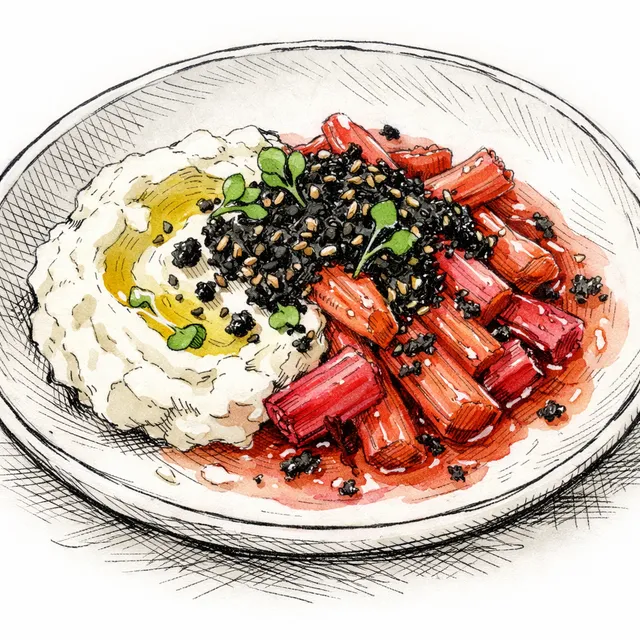
Spring Contrast: Hot-Macerated Rhubarb with Cold Olive Oil Ricotta
I used to boil rhubarb into a stringy, unpredictable jam. It tasted fine, but the texture was a casualty of impatience. This recipe was born from a fine-dining service years ago where we needed perfect rhubarb batons in ten minutes without turning them to mush. The solution? Hot maceration. Pouring a boiling syrup over raw rhubarb gently cooks it while retaining its architectural integrity. Precision is freedom. ### Why this works We pair the warm, tart rhubarb with aggressively chilled, grassy olive oil whipped ricotta. The two-texture rule is in full effect here, driven by temperature management. The fast stovetop black sesame crumble adds a necessary, slightly bitter crunch to cut the sweet syrup. Contrast is the secret ingredient. ### Make it yours If you do not have black sesame, toasted pistachios (weighed to 50 grams, naturally) work beautifully. Add a microplane of yuzu or lemon zest to the ricotta if you want to push the citrus lane. Grab your scale. Wipe down your counter. Set a timer. Let the rhubarb cool slightly in the syrup before plating. Future you deserves clean slices and restaurant-level payoff.
Featured Recipe
Hot-Macerated Rhubarb with Cold Olive Oil Ricotta & Black Sesame Crumble
We are not adding steps—just improving decisions. A hot-syrup maceration yields perfectly tender rhubarb without the mush of boiling. Paired with grassy olive oil whipped ricotta and a fast stovetop black sesame crumble, this is high-signal spring contrast.
Save a copy to your collection for editing
Timeline
Ingredients
- 400 g rhubarb(Cut into precise 2cm batons)
- 100 g granulated sugar(For the maceration syrup)
- 50 g fresh orange juice(Strained)
- 20 g white wine vinegar(Provides necessary acidic backbone)
- 5 g orange zest(Microplaned)
- 60 g unsalted butter(For browning)
- 50 g rolled oats(Do not use quick oats)
- 40 g all-purpose flour(Binds the crumble)
- 30 g dark brown sugar(For caramel notes in the crumble)
- 15 g black sesame seeds(One-contrast upgrade)
- 3 g flaky sea salt(For finishing the crumble)
- 250 g whole milk ricotta(Drained if watery, kept cold)
- 30 g extra virgin olive oil(Fruity and grassy)
- 15 g powdered sugar(Sifted)
Instructions
- 1
Place 400g rhubarb into a heatproof glass or ceramic bowl. Ensure your cuts are uniform so they temper at the exact same rate. Set aside.
5 min
Tip: Wipe your cutting board immediately. A clean station keeps the mind clear.
- 2
In a small saucepan, combine 100g granulated sugar, 50g fresh orange juice, 20g white wine vinegar, and 5g orange zest. Bring to a rolling boil over medium-high heat until the sugar completely dissolves.
4 min
Tip: Watch the pot. We want a rapid boil to ensure enough thermal mass to soften the rhubarb without a stove-top simmer.
- 3
Pour the boiling syrup directly over the rhubarb in the bowl. Immediately cover tightly with plastic wrap or a heavy lid. The trapped residual heat will gently break down the cell walls without turning the fruit to jam. Let it sit for at least 15 minutes.
2 min
Tip: This is temperature management at its simplest. The rhubarb will release its own juices, creating a brilliant pink syrup.
- 4
While the rhubarb macerates, build the stovetop crumble. In a wide skillet over medium heat, melt 60g unsalted butter until it foams, subsides, and smells distinctly nutty.
3 min
Tip: Listen to the butter. When the crackling stops, the water is gone and the browning begins.
- 5
Add 50g rolled oats, 40g all-purpose flour, 30g dark brown sugar, and 15g black sesame seeds to the brown butter. Toast, stirring constantly with a wooden spoon, until the mixture is golden and smells like toasted nuts. Off heat, stir in 3g flaky sea salt.
6 min
Tip: Keep the mixture moving to avoid scorching the flour.
- 6
Immediately spread the hot crumble mixture onto a flat plate or small sheet pan in an even layer. Let it cool completely. Future you deserves clean, crunchy clusters.
2 min
Tip: Spreading it out halts the cooking process and allows the sugars to crystallize into a shatter.
- 7
In a chilled mixing bowl, vigorously whisk 250g whole milk ricotta, 30g extra virgin olive oil, and 15g powdered sugar until aerated, thick, and smooth. Keep cold until ready to plate.
3 min
Tip: The olive oil acts as an emulsifier and a savory bridge, bringing depth to the clean dairy.
- 8
To serve, swipe a generous dollop of the cold ricotta across a shallow bowl. Spoon the warm or room-temperature rhubarb and a little of its vivid pink syrup into the center. Scatter aggressively with the cooled black sesame crumble.
2 min
Tip: Respect the two-texture rule: smooth ricotta against shattering crumble. Serve immediately.
Chef's Notes
Precision is freedom. Weigh your ingredients and respect the resting times. The hot-syrup maceration technique can be applied to almost any dense spring fruit, but rhubarb yields the sharpest contrast. Ensure your crumble cools entirely on a flat surface; steam is the enemy of crunch.

Theo Glass
Modern desserts, minimal fuss, maximum contrast.
Theo Glass—known as “The Minimalist Sweet Tooth”—is a calm, detail-obsessed pastry coach who left the white-tablecloth intensity of fine dining for the reality (and joy) of home kitchens. After years of building plated desserts with tweezers and timers, he realized the real magic wasn’t complicated garnish work—it was contrast, clarity, and control. Theo’s mission now is to help everyday bakers make desserts that feel modern and restaurant-level without turning their kitchen into a war zone. His style is precision with restraint: olive oil cakes that stay plush for days, tahini brownies that walk the line between nutty and bittersweet, miso custards that taste like “caramel’s smarter cousin,” and citrus-forward sorbets that pop without needing an ice-cream machine. Theo teaches fundamentals (emulsions, temperature, texture, salinity) in plain language, with steps that are clean, paced, and confidence-building. If you’ve ever said “I want to mix it up” but don’t want extra dishes, obscure tools, or chaos, Theo’s your person. He’ll show you how to mix it up the minimalist way: a smarter ingredient swap, a sharper contrast, and a clear path to repeatable results.